Every Tuesday afternoon we publish a collection of topics and give our expert opinion about the Equity Markets.

Venezuela has returned to the centre of investor and policy conversations, but not via conventional economic pathways. Earlier this month, United States forces executed a military operation in Caracas that resulted in the capture of Venezuelan President Nicolás Maduro and his wife; both were subsequently flown to the U.S. and arraigned on federal drug-trafficking and related charges in New York. This extraordinary geopolitical event compounds more familiar developments, a striking rally in the Caracas stock exchange, the renewed flow of Venezuelan crude to U.S. ports under narrow sanctions relief, and an energy sector still grappling with years of underinvestment.
At the centre of the Venezuela story sits oil. The country holds the largest proven oil reserves in the world, estimated at around 300 billion barrels. That stockpile represents roughly 17% of global reserves and exceeds those of traditional energy heavyweights such as Saudi Arabia. On paper, Venezuela should be one of the most strategically important energy producers on the planet.
For investors and markets, Venezuela today encapsulates a fundamental paradox: asset prices are moving, capital is stirring, yet the underlying economic foundations remain fragile. Venezuela today is a case study in how markets can respond to constraint and scarcity rather than confidence or recovery.
A Market Rally Without a Healthy Economy
The rally in Venezuela’s domestic equity market has drawn attention precisely because it appears so counterintuitive. Equities are rising in an economy still under severe macroeconomic pressure. The explanation lies less in optimism and more in structure. The Caracas exchange is small and illiquid, with fewer than 40 actively traded stocks and very limited foreign participation.
|
Source: tradingeconomics.com |
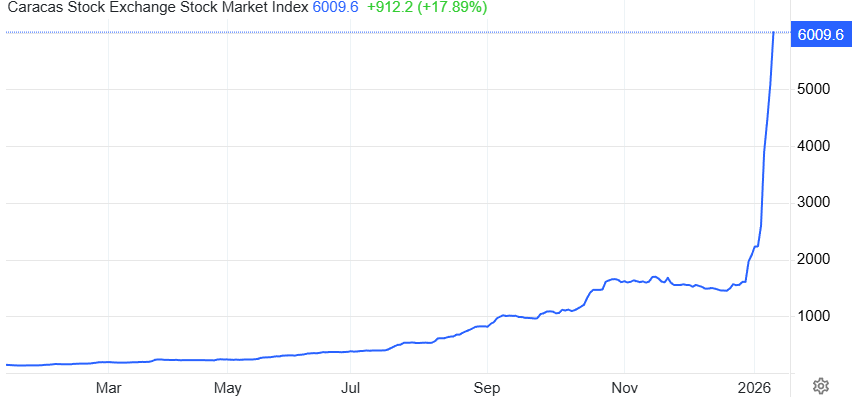
In this environment, prices are shaped by the lack of alternatives rather than improving fundamentals. Persistent inflation, capital controls and restricted access to foreign currency have left domestic investors with few ways to preserve value. Equities have become a substitute store of wealth rather than a vote of confidence in corporate growth. This pattern is not unusual in financially repressed economies and should not be mistaken for a broader economic turning point.
Capital Flows Without Commitment
The geopolitical event has, unsurprisingly, stirred financial markets beyond Venezuelan borders. Speculative capital is engaging in currency and equity trades that reflect event-driven positioning rather than sustainable valuation confidence. Yet it is crucial to distinguish short-term liquidity flows from long-term capital commitment.
The sanctions carve-outs enabling limited oil exports and modest financial reopening remain narrow and highly reversible. Investors allocating capital for the long term require clarity around governance, legal protections, contract enforcement and policy continuity. Those foundations are still in flux. Markets may react quickly to headlines, but sustained investment tends to wait for institutional certainty.
Commodity Implications: Optionality More Than Abundance
For global energy markets, Venezuelan oil provides flexibility rather than abundance. These barrels help ease near-term tightness at the margin, but they do little to change the broader supply picture shaped by years of global underinvestment. Production constraints, infrastructure decay and operational risk limit Venezuela’s ability to play a meaningful long-term role.
This has broader implications for resource investors. Jurisdictions with stable policy settings, transparent regulation and credible institutions continue to command a premium. Supply reliability increasingly matters as much as resource endowment itself.
For Australian investors and resource strategists, Venezuela serves as a reminder of where value tends to gravitate. Natural resources only become investable assets when supported by frameworks that allow capital to be deployed with confidence.
The BPC View
Venezuela’s recent developments sit at the intersection of geopolitics, constrained markets and distorted capital signals. The capture and extradition of Nicolás Maduro is a significant geopolitical moment, but it does not, on its own, resolve the deeper economic and institutional challenges facing the country. Similarly, rising asset prices and renewed oil exports reflect scarcity, positioning and political recalibration rather than a genuine economic reset.
For investors, the lesson is one of perspective. Price action and headlines can move quickly, often ahead of fundamentals. Durable value, however, continues to be anchored in transparency, enforceable rules and institutional continuity. Rallies in distressed markets may be compelling to watch, but they rarely substitute for the long, steady work of economic rebuilding.
Distinguishing between liquidity-driven moves and sustainable valuation drivers remains central to thoughtful capital allocation, particularly across emerging markets and resource-linked exposures.
We offer value-rich content to our BPC community of subscribers. If you're interested in the stock market, you will enjoy our exclusive mailing lists focused on all aspects of the market.
To receive our exclusive E-Newsletter, subscribe to 'As Barclay Sees It' now.